Reclaimed Wormy Chestnut Or Heart Pine: Which Antique Floor Suits Your Home?

Updated: 2 days ago

Wormy chestnut, heart pine and old-growth Douglas fir: nine ideas for choosing a reclaimed antique floor, from grade and width to moisture, finish and cost.
Considering a reclaimed antique floor? Talk with Joe Avila: call 908-232-6600 or book a virtual consultation.
Some woods can no longer be cut from a living forest. Wormy chestnut and old-growth heart pine survive only as reclaimed flooring, milled from the beams and boards of buildings that stood for a century or more. Here is how to choose between them, and where old-growth Douglas fir fits, for homes from San Francisco to the Peninsula, Marin and wine country.
1. Why These Woods Exist Only As Reclaimed Flooring

American chestnut once filled the Eastern forests. In the first half of the twentieth century, chestnut blight killed nearly all of the mature trees, and the species never recovered as a timber source. Longleaf pine, the source of true heart pine, was logged across the Southeast until its old-growth stands were largely gone.
What remains is the wood already in service: barn siding, mill beams, warehouse joists and old floors. Reclaiming it means dismantling, removing metal, drying and resawing each piece before it is milled into tongue and groove planks. That history is the appeal, and it is also why supply is limited and every lot looks a little different.
2. Wormy Chestnut: Quiet Color, Visible History
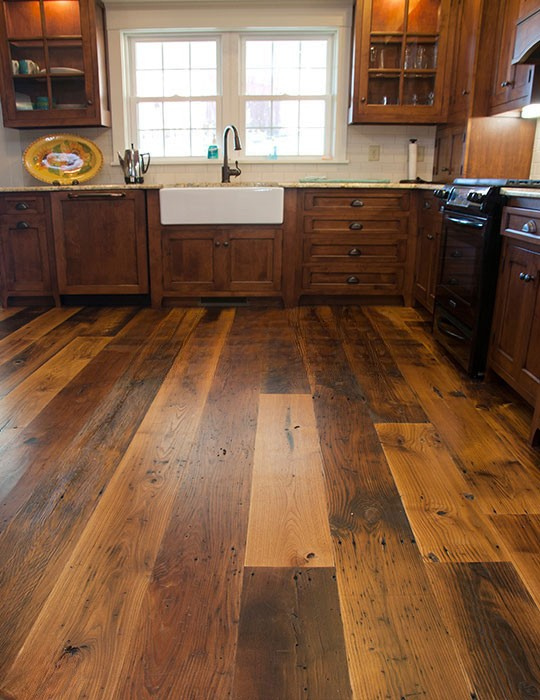
Chestnut has an open, coarse grain that resembles oak, but in a softer, warmer brown that deepens with age. The "wormy" name comes from the small holes and tracks left by insects in timber from blight-killed trees. They read as a fine, scattered texture rather than damage, and they are what most buyers are looking for.
Our Antique Reclaimed Wormy Chestnut is American chestnut with a smooth texture and occasional saw marks, prefinished in UV Natural Oil or UV Matte Oil. It is offered in solid or engineered 3/4 inch platforms, in 3 to 6 inch or 4 to 8 inch random widths and random lengths from 2 feet up to 12 feet. In a Pacific Heights library or a paneled study, its tone sits comfortably beside walnut and painted millwork.
3. Heart Pine: Dense Old-Growth Heartwood

Heart pine is the heartwood of longleaf pine that grew slowly for centuries, packing many growth rings into each inch. The result is a dense, resinous wood with a deep amber to russet color and a strong contrast between earlywood and latewood. It continues to darken and warm with exposure to light.
That color makes heart pine a natural partner for warm palettes, natural plaster and the soft light of fog-filtered rooms. It suits Edwardian interiors, Napa farmhouses and wine-country estates, and modern rooms that need one warm, historic surface. Like any softwood, it will take marks from heels and furniture, which most owners accept as part of an aged patina.
Comparing chestnut, heart pine and fir for your project? Call Joe Avila at 908-232-6600 or book a virtual consultation.
4. Reading Heart Pine Grades: Select To Original Face

Reclaimed heart pine is sold by how much of its history shows. Heart Pine Select has a smooth, refined face. Heart Pine Common keeps a smooth texture with authentic saw marks and more variation. Hit-Skip, a term for boards the planer hit in some places and skipped in others, leaves patches of the original surface beside fresh wood.
Original Face goes furthest: heavy saw marks and a deep natural patina, prefinished in UV Natural Oil. The widest options on our heart pine pages, 8 to 12 inch random widths, appear on Hit-Skip and Original Face. Select reads as a calm, formal field; Original Face reads as a room's main texture.
5. Douglas Fir And The San Francisco Victorian

If chestnut and heart pine belong to the East and South, old-growth Douglas fir is the West's own. Fir framed much of San Francisco, and many Victorian and Edwardian houses still have original fir floors, sometimes laid as a subfloor beneath a later oak floor or border. Reclaimed fir is often the honest choice when a room has to sit beside that original wood. For one neighborhood's houses, see our post on antique reclaimed Douglas fir for Mission District Victorians.
Our Antique Reclaimed Douglas Fir is American fir with a smooth texture, prefinished in UV Natural Oil or UV Matte Oil, in 3 to 6 or 4 to 8 inch random widths. Hand-scraping, wire brushing and end matching up to 12 inches are listed as custom options. When an addition must meet an existing floor, compare samples in place, the way we approach matching existing floors.
6. The Specialist Detail: Moisture Before Character

Old wood is not automatically stable wood. Reclaimed boards have spent decades in barns or mills at moisture levels nothing like a foggy Sunset District room or a dry Tahoe lodge. Ask how the material was dried, then measure the flooring and the subfloor with a meter set to the correct species before installation.
NWFA guidance gives a working target: for strip flooring under 3 inches wide, the moisture content of flooring and subfloor should be within 4 percent of each other; for planks 3 inches or wider, within 2 percent. Reclaimed planks are usually wide, so the tighter figure applies. Skipping this step is a common cause of cupping, gaps and checking.
Planning moisture checks and installation for an antique floor? Talk with Joe Avila: call 908-232-6600 or book a virtual consultation.
A reclaimed floor carries a century of history, but it still has to settle into the house it is going into. Measure first, then admire the patina.
7. Solid Or Engineered In Bay Area Houses

The reclaimed products on our site come in both solid and engineered 3/4 inch platforms, and the engineered version carries a 4mm nominal wear layer. Engineered construction can go over plywood or concrete, which makes it the usual answer for slabs and radiant heat in Peninsula and Marin new construction.
Solid reclaimed wood suits joisted floors over a dry, well-ventilated crawlspace, as long as crawlspace moisture is controlled first. For particularly wide planks, the product pages note that gluing and nailing together is good practice. On hillside and seismically retrofitted houses, check that the subfloor is flat and stiff before choosing wide, long boards; old wood shows every hump.
8. What Shapes The Price Of Reclaimed Flooring

Searches for wormy chestnut flooring prices are common, and the honest answer is that cost follows scarcity and labor. Chestnut can only be salvaged, and every board has to be de-nailed, dried, resawn and milled. Heart pine depends on grade: on our product pages, Common sits at the lower end of the heart pine range, with Select and Original Face higher.
Width, length and construction move the figure too, as they do for any wide plank floor. Wider random widths, solid versus engineered, and custom work such as end matching, same-width planks or beveled edges all change the quote. Blends such as Trophy Room flooring, which mixes walnut, chestnut and cherry, are priced on their own pages. For a quote on your square footage, call 908-232-6600.
9. Finishing And Living With An Antique Floor

Each of these reclaimed floors is offered prefinished in UV oil, cured in the factory, so the house is spared a full site-applied finish. If you prefer custom finishing, test it first: heart pine's resin can slow the drying of some coatings, and site finishes in the Bay Area must meet California and Bay Area Air District low-VOC rules.
Chestnut, heart pine and fir are softer than white oak, so heels and pets will leave marks. A matte oil hides them well and can be renewed with a maintenance oil. Keep grit off the floor and control humidity, as our wood floor care guide explains, and the floor will keep gaining depth.
Quick Answers
Is wormy chestnut flooring still available new?
Almost never. Chestnut blight killed nearly all mature American chestnut trees in the early twentieth century, so the chestnut flooring sold today is reclaimed from old barns and buildings, then resawn and milled into new planks.
What is the difference between heart pine and ordinary pine flooring?
Heart pine is the dense, resin-rich heartwood of slow-grown, old-growth longleaf pine. Its tight growth rings and deep amber color set it apart from fast-grown plantation pine, which is mostly pale, softer sapwood.
What makes reclaimed wormy chestnut flooring cost more?
Scarcity drives it: chestnut can only be salvaged, and each board must be de-nailed, dried, resawn and milled. Grade, width, solid or engineered construction and custom work such as end matching also shape the price. Call 908-232-6600 for a quote.
How do I get wormy chestnut flooring prices for my project?
Ask for a quote based on your rooms and the options you choose. Our Antique Reclaimed Wormy Chestnut comes solid or engineered 3/4 inch, in 3 to 6 or 4 to 8 inch random widths. Width, construction, your square footage and custom work such as end matching all shape the total. Call 908-232-6600 with your room sizes.
Can reclaimed heart pine or chestnut go over radiant heat?
The engineered versions can. The reclaimed heart pine and chestnut on our site list an engineered 3/4 inch platform with a 4mm nominal wear layer for plywood or concrete subfloors. Review radiant systems and moisture with Joe Avila before ordering.
Plan Your Reclaimed Antique Floor With Joe Avila
Call 908-232-6600, email joe@hugginsflooring.com or book a virtual consultation.
Ready to choose your floor? Book a virtual design consultation, request a sample box, or call (908) 232-6600, 9am to 5pm Eastern. We ship and deliver throughout San Francisco, the Peninsula and the Bay Area.
Explore our wide plank, herringbone and parquet floors, Wood Available Now, species guide, eco-friendly finishes and buying guide.
Main office: 406B West Broad Street, Westfield, NJ 07090. We ship and deliver wood flooring throughout San Francisco and the Bay Area.
About The Author
Joe Avila leads San Francisco Wood Floors, part of Huggins Wood Floor Specialist, and brings 26 years of experience in wood flooring. He is an NWFA-certified wood flooring inspector, installer and sander, and has taught accredited AIA, ASID and IDCEC programs for more than a decade. He advises homeowners, designers and architects from species, grade and pattern through subfloors, moisture control and installation. To plan a floor, visit San Francisco Wood Floors.


Comments